
Who should attend
- Virtual Machine Administrators who are looking to virtualize workloads from traditional Hypervisors to OpenShift Virtualization.
- Platform Engineers, Cloud Administrators, and System Administrators who are interested in supporting virtualized workloads, either independently from or in the same OpenShift cluster as containerized workloads.
Prerequisites
Although Linux skills are not required for managing OpenShift clusters and OpenShift Virtualization, operating individual Linux VMs requires Linux system administration skills that the Red Hat System Administration I (RH124) and Red Hat System Administration II (RH134) courses provide.
Course Objectives
Impact on the Organization
OpenShift Virtualization enables organizations to realize operational savings by managing virtualized workloads and containerized workloads together using the same orchestration and clustering infrastructure provided by Red Hat OpenShift.
Impact on the Individual
IT professionals will learn to deploy and manage virtualized workloads on OpenShift, including in multicluster environments.
Detailed Course Outline
Introduction to Kubernetes and OpenShift
Identify the main Kubernetes cluster services and OpenShift platform services and monitor them by using the web console.
Kubernetes and OpenShift Command-line Interfaces and APIs
Access an OpenShift cluster by using the command line and query its Kubernetes API resources to assess the health of a cluster.
Run Applications as Containers and Pods
Run and troubleshoot containerized applications as unmanaged Kubernetes pods.
Deploy Managed and Networked Applications on Kubernetes
Deploy applications and expose them to network access from inside and outside a Kubernetes cluster.
Introduction to Red Hat OpenShift Virtualization
Deploy the OpenShift Virtualization operator and examine the configuration options for the operator.
Creating, Managing, and Monitoring Virtual Machines in Red Hat OpenShift Virtualization
Create, manage, and monitor virtual machines in Red Hat OpenShift Virtualization
Virtual Machine Networking in Red Hat OpenShift Virtualization
Use comprehensive and flexible networking for virtual machines within an OpenShift environment.
Managing Storage for Virtual Machines in Red Hat OpenShift Virtualization
Configure and manage persistent storage for virtual machines, protect VM data through snapshots, export and import virtual machine images, and efficiently create golden images for virtual machines by using cloning within a Red Hat OpenShift Virtualization environment.
Authentication and Authorization for Virtual Machines in Red Hat OpenShift Virtualization
Understand OpenShift OAuth server concepts and custom resources, including their function in Kubernetes authentication, and define and implement role-based access controls and user permissions.
Advanced Virtual Machine Networking in Red Hat OpenShift Virtualization
Enable comprehensive and flexible networking for nodes and virtual machines within an OpenShift environment.
Migrating Virtual Machines to Red Hat OpenShift Virtualization
Migrate virtual machines from another hypervisor to Red Hat OpenShift Virtualization by using the migration toolkit for virtualization (MTV) operator.
Creating and Restoring Backups of Virtual Machines in Red Hat OpenShift Virtualization
Back up and restore virtual machines by using the OpenShift APIs for Data Protection (OADP) operator.
Creating Custom Instance Types, Templates, and Boot Sources in Red Hat OpenShift Virtualization
Create and manage custom instance types, templates, and boot sources to provision virtual machines.
Controlling Scheduling of Virtual Machines in Red Hat OpenShift Virtualization
Control the placement of virtual machines on cluster nodes by using Kubernetes resources and rebalance virtual machine workloads across cluster nodes by enabling descheduler evictions.
Configuring High Availability for Virtual Machines
Implement high-availability virtual machines that are resilient to failures, planned maintenance, and cluster upgrades by configuring Kubernetes resources.
Installing Red Hat Advanced Cluster Management for Kubernetes
Describe and implement the RHACM architecture and its components, and follow recommended practices for its installation.
Managing Clusters by Using Red Hat Advanced Cluster Management for Kubernetes
Import and manage a cluster by using the RHACM web console, configure user access to clusters, and troubleshoot common import issues.
Deploying and Managing Policies for Multiple Clusters with Red Hat Advanced Cluster Management for Kubernetes
Deploy and manage policies in a multicluster environment by using RHACM governance.
Managing Virtual Machines for Multiple Clusters with Red Hat Advanced Cluster Management for Kubernetes
Deploy and manage virtual machines in a multicluster environment by using RHACM and GitOps
Course Content
The OpenShift Virtualization Boot Camp for Administrators (DO730) immerses you in intensive, hands-on management of OpenShift Virtualization Operator and OpenShift Virtualization Engine deployed on Red Hat's implementation of Kubernetes, Red Hat® OpenShift® Container Platform, at enterprise scale. This course is for those seeking to adopt a cloud-native infrastructure to run and deploy virtual machine (VM) workloads on a modern platform in their digital transformation journey. Making this shift requires the ability to support the migration and management of traditional VMs onto a hybrid cloud application platform, such as OpenShift Virtualization. The skills learned in this course can be applied to both OpenShift Container Platform and OpenShift Virtualization Engine in order to deploy and use a modern platform for running VMs. This course extends these skills to multi-cluster environments, covering the installation and use of Red Hat Advanced Cluster Management for Kubernetes (RHACM) to manage clusters, enforce policies, and oversee VMs across your hybrid cloud.
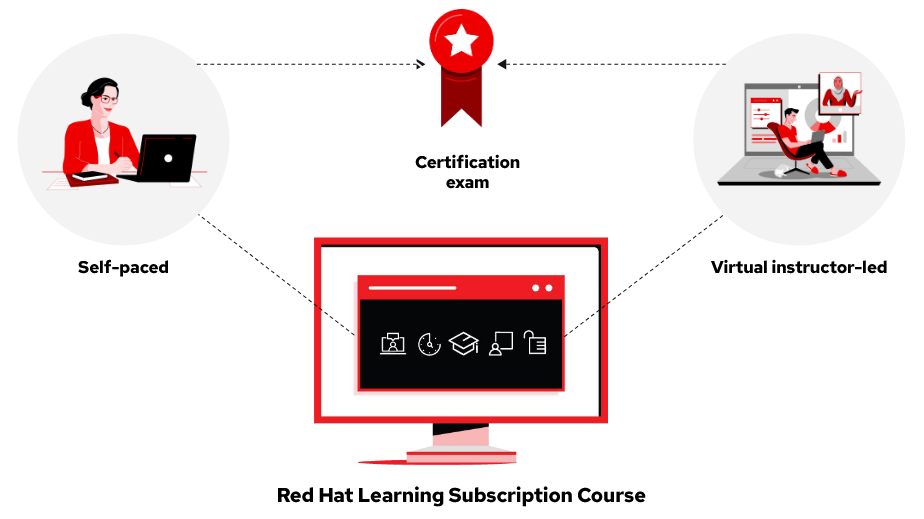
As part of enrollment, you will receive one year of Red Hat Learning Subscription Standard, which gives you unlimited access to all of our courses online, and can take up to 5 unique exams and can retake any of those exams in the event you do not successfully pass.
Course Content Summary
- Introduction and overview of containers
- Container orchestration with OpenShift and Kubernetes
- Managing OpenShift clusters from the command-line interface and from the web console.
- Getting started with Red Hat OpenShift Virtualization
- Managing authentication and authorization for virtual machines in OpenShift
- Running and accessing virtual machines
- Configuring Kubernetes networking for virtual machines
- Isolating virtualized applications though network policies and user-defined networks
- Configuring storage for virtual machines
- Advanced virtual machine and boot source management
- Configuring high availability for virtual machines with Kubernetes resources
- Managing multiple clusters and virtual machines with Red Hat Advanced Cluster Management for Kubernetes (RHACM)